
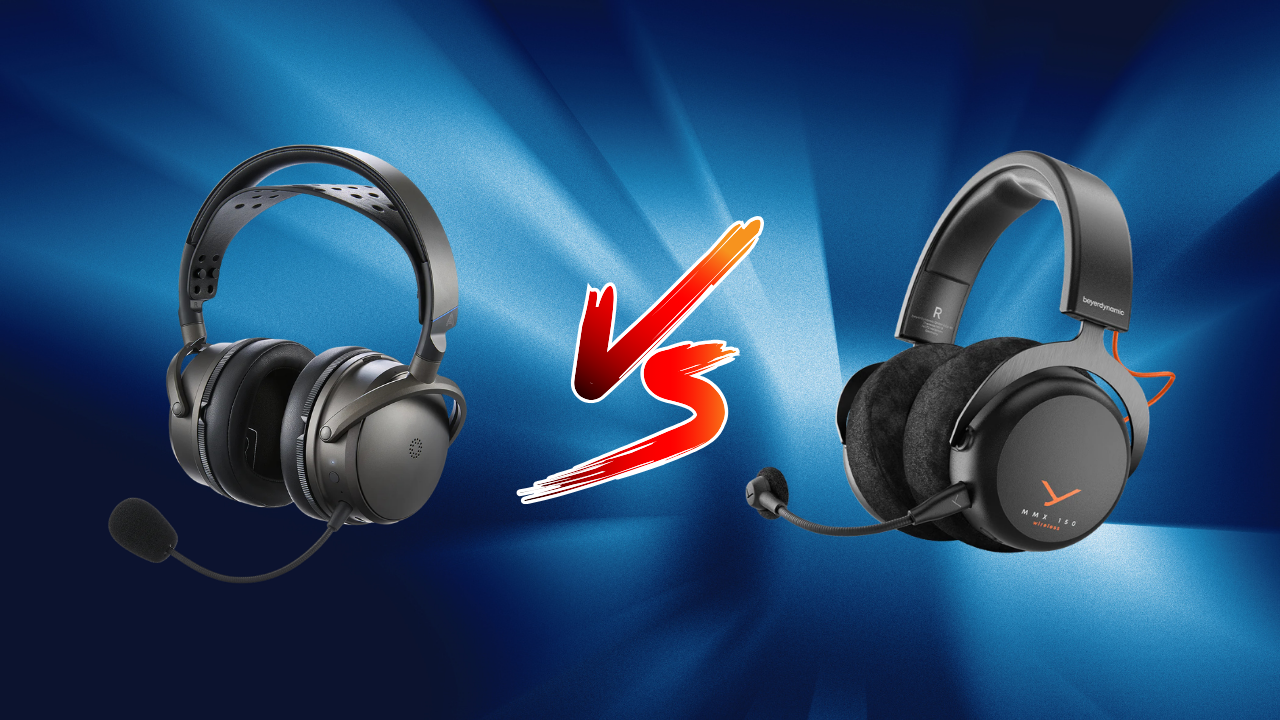
Wireless gaming headsets have started to blur the line between convenience and high-fidelity sound, but not all of them approach that balance in the same way. The Audeze Maxwell 2 and Beyerdynamic MMX 150 Wireless represent two distinct philosophies, one rooted in audiophile-grade performance, the other in accessible, everyday usability. Both aim to deliver strong wireless performance for gaming, but their differences become clear once you start looking at how they’re built and, more importantly, how they sound.
What You Get
| Maxwell 2 | MMX 150 |
|
|
Look & Feel
The Audeze Maxwell 2 carries over the brand’s signature industrial design, emphasizing durability and substance, while the Beyerdynamic MMX 150 Wireless takes a more traditional and lightweight approach. The Maxwell has always felt like a serious piece of hardware, with a sturdy frame and dense construction that reflects its premium positioning, but the MMX 150 can be seen as more approachable with its consumer-friendly looks. It doesn’t have the same premium density as the Maxwell 2, but it compensates with a more relaxed and practical form factor that suits everyday gaming and listening. The Maxwell 2 is comfortable, but they’re certainly weightier, which can be strenuous on long gaming sessions.
Design
Under the hood, the biggest distinction comes down to driver technology and feature set. The Maxwell 2 is built around planar magnetic drivers, which is a defining characteristic rarely seen in gaming headsets. This allows it to achieve a higher level of precision and control across the frequency range. It also includes a robust wireless system with multiple connection options, along with software-based customization that lets you fine-tune the listening experience.
The MMX 150 Wireless uses a more traditional dynamic driver design, focusing on balance and versatility. It keeps things straightforward, offering a reliable wireless connection and intuitive controls without overcomplicating the experience. It’s designed to work seamlessly across different use cases, making it a more flexible option for users who want something simple and effective.
Microphone Quality
Both headsets include detachable microphones designed for gaming and communication. The Maxwell 2 offers a clear and functional mic that integrates well with its overall feature set. It’s a dependable option for voice chat, delivering intelligible speech without drawing too much attention to itself. The MMX 150 Wireless follows a similar path, with a mic that prioritizes usability and consistency. Neither headset positions itself as a broadcast-level solution, but both deliver what’s needed for in-game use.
Bluetooth & Battery Life
Both headsets support modern wireless connectivity, but they prioritize it differently. The Maxwell 2 is positioned as a feature-rich platform, offering multiple wireless modes and long battery life. The MMX 150 Wireless also delivers solid battery performance, though its focus is more on practicality than pushing limits. It may not match the Maxwell 2 in sheer endurance, but it remains reliable for typical gaming sessions.
Soundstage
The Audeze Maxwell 2 delivers a noticeably wider and more three-dimensional soundstage, creating a sense of space that feels closer to open-back audiophile headphones than a typical closed-back gaming headset. Sounds extend well beyond the ear cups, with strong lateral width and convincing front-to-back depth. This makes environmental cues in games feel more natural and layered, especially in open-world titles or cinematic experiences. Imaging is particularly sharp, allowing you to pinpoint directional audio with high accuracy, a major advantage in competitive scenarios. The Beyerdynamic MMX 150 Wireless, while still competent, presents a more intimate soundstage. The space feels closer and more centered, which can actually benefit certain use cases like dialogue-heavy games or voice chat, where proximity helps maintain focus. Imaging remains accurate, but it doesn’t separate layers with the same precision as the Maxwell 2. Instead of a large, immersive field, the MMX 150 offers a tighter, more cohesive presentation that feels controlled and easy to follow.
Low End
The Maxwell 2’s low end is defined by control and texture rather than sheer quantity. Thanks to its planar magnetic drivers, bass notes are fast, tight, and highly detailed, with very little bloom or bleed into the mids. On the other hand, the MMX 150 Wireless leans into a warmer and more relaxed bass response. There’s more mid-bass presence here, which gives music and games a fuller, slightly thicker foundation. While it doesn’t have the same level of speed or articulation as the Maxwell 2, it feels more immediately engaging for casual listening. Bass notes linger a bit longer, creating a softer, more rounded presentation that prioritizes enjoyment over precision. This tuning works well for long sessions where you want a forgiving, non-fatiguing sound.
Mids
The midrange is where the Maxwell 2 truly separates itself. Vocals, dialogue, and midrange instruments come through with exceptional clarity and resolution. There’s a neutral-to-slightly-forward tuning here that ensures voices cut through the mix cleanly without sounding unnatural. With the MMX 150 Wireless, you get a smoother and more colored midrange in comparison. It doesn’t aim for the same level of analytical detail, instead opting for a more relaxed and musical presentation. Vocals still come through clearly, but they sit slightly back in the mix, blending more with surrounding elements. This creates a cohesive sound that’s easy to listen to for extended periods, though it sacrifices some of the micro-detail and separation found in the Maxwell 2.
Highs
Treble performance on the Maxwell 2 is extended and highly resolving, providing a crisp and airy top end that enhances detail retrieval. High-frequency elements like footsteps, environmental cues, and subtle reverbs are presented with clarity and precision. In contrast, the MMX 150 Wireless takes a more conservative approach to the highs. The treble is softer and more rolled off, reducing the risk of sibilance or sharpness but also limiting overall detail. This makes it a safer option for listeners who are sensitive to bright sound signatures. While you won’t get the same level of sparkle or micro-detail, the smoother treble contributes to a more laid-back and forgiving listening experience that pairs well with its warmer overall tuning.
Summary
The Audeze Maxwell 2 and Beyerdynamic MMX 150 Wireless ultimately serve different types of listeners. The Maxwell 2 is built for those who want a more refined and detailed listening experience, bringing audiophile-level performance into a gaming format. Its soundstage, clarity, and overall precision place it in a category that goes beyond typical gaming headsets. The MMX 150 Wireless, on the other hand, focuses on accessibility and comfort. It offers a balanced, easy-to-enjoy sound signature and a lightweight design that makes it ideal for everyday use. If your priority is sound quality and technical performance, the Maxwell 2 stands out. But if you’re looking for something more relaxed, comfortable, and versatile, the MMX 150 Wireless remains a compelling alternative.
The Audeze Maxwell 2 and Beyerdynamic MMX 150 Wireless are available at Audio46.
MAJORHIFI may receive commissions from retail offers.