
Final Audio has never been a brand to follow trends blindly, and the Tonalite true wireless earphones feel like a deliberate step into uncharted territory. Rather than competing purely on noise-canceling specs or flashy features, the Tonalite is built around a more ambitious goal: tailoring sound to the individual listener through Final’s DTAS sound personalization technology. Let’s explore how that philosophy translates into real-world listening, examining the Tonalite’s design, functionality, Bluetooth performance, battery life, and, most importantly, how its personalized tuning reshapes the listening experience. For listeners curious about the future of custom-tuned true wireless earbuds, the Tonalite presents a compelling case.
What You Get
- Tonalite Earphones
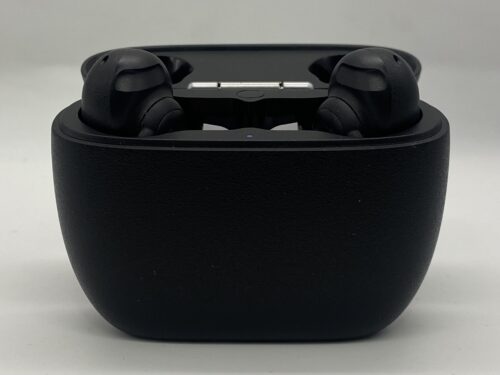
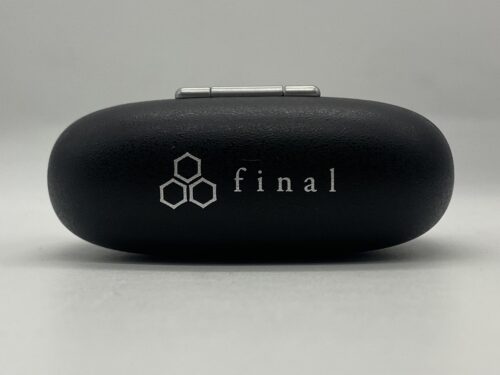
- Charging case
- Headband
- Two sets of AR stickers
- 3 pairs of Final Audio Fusion G eartips
- One additional set of rubber wingfins
- 5 pairs of nozzle filters
- User guide
Look & Feel
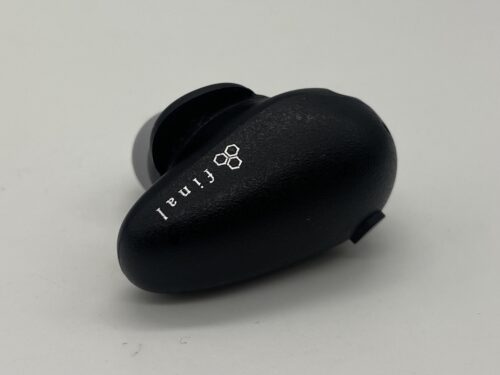
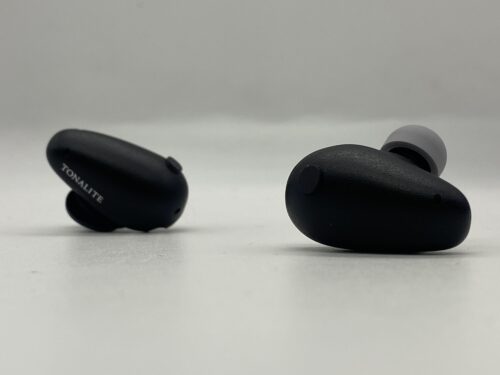
The Tonalite doesn’t resemble anything Final Audio has made yet. Although the material of the shell reminds me of the texture of products like the ZE8000 MKII, the shape of the Tonalite is larger than the others in their selection, but its stemmed design allows the housing to hang outside of your ear. A small rubber wingfin is provided to add extra support to hold the earphones in place. This allows for a comfortable fit that feels secure while listening for long hours.
Design & Functionality
Everything about the Tonalite’s driver configuration is centered around its DTAS technology. The driver is a 10mm dynamic unit that is powered by Final’s f-CORE technology, which is custom-made for this new, highly advanced sound personalization feature. It’s a capable unit that has its own volume step option that allows you to optimize volume control, allowing for subtler loudness adjustments. It’s like a volume preset where you can set your preferred listening level for the exact kind of loudness you want.
The Tonalite has noise-canceling and ambient awareness, which is less of a focus on these earbuds, but it still offers effective isolation. Indoor vents will be totally muted, but outdoor obstructions and voices still make their way through.
Downloading the companion app for the Tonalite is a must to experience everything these earbuds have to offer. There’s the core of the Tonalite, which is its DTAS sound personalization, but it also houses a 10-band EQ and custom touch controls. The Tonalite responds very well to touch actions, consistently responding to taps and registering them smoothly.
Bluetooth
For connectivity and performance, the Tonalite uses Bluetooth 6.0 with support from LDAC for clearer audio transmission and low latency. There’s also a separate function in-app for multipoint connection, going as far as to retain your DTAS sound personalization across different devices.
Battery Life
Battery performance is strong for this class of earbuds: a full charge of the earbuds offers up to approximately 8–9 hours of playback on a single charge, with variations depending on ANC and usage conditions. The charging case significantly extends total listening time, providing roughly 24–27 hours of combined battery life before a recharge is needed.
Sound Impressions
Discussing the sound of the Tonalite will be different from how I usually approach my listening analysis. I’ve tried out earphones with personalized sound testing before, but when using the DTAS 3D head scanning in Final’s app, it becomes apparent that this is a more advanced method. Setting up your personalized timbre requires a more involved procedure than just reacting to beeps played at different volume levels. In fact, the whole process takes a considerable amount of time to complete, depending on several factors, such as following the steps closely and the duration of experimentation with the timbre coefficient.
The Tonalite has a standard tuning, but it becomes almost an afterthought when you hear what your personalized timbre. There’s really no reason to go back to it, despite not being too bad on its own. DTAS brings the sound to another level, though, but it makes reviewing the sound of the Tonalite a bit more complicated. These earbuds are tuned to my ears, so the following section will be even more subjective than usual.
Soundstage
The Tonalite achieves different levels of width, depth, and dimension depending on your DTAS results, but overall, it’s very impressive. Using the general tuning allows for basic, linear localization with a strong width for true wireless earphones. It communicates spatial positioning simply but effectively. When using my personalized sound, the soundstage expands to a grander scale, which I was pleasantly surprised by.
The imaging became more non-linear, and the headspace grew taller. I felt the sound less in the middle of my head, and more spread out to the left and right channels, giving the instruments and effects better spatial identity. This is not a 3D mode; it’s just more natural separations and layering you would see on a good pair of IEMs or a closed-back headphone. I spent a lot of time switching between the three different timbre coefficients because I was trying to decide if I wanted the imaging to have more height or body. Ideally, I would have both, but I found a nice sweet spot for my personalized sound that I thought ultimately elevated the soundstage enough to be satisfied with.
Low End
When I heard the general sound profile of the bass for the Tonalite, I was impressed by how thick a tone it portrayed. It’s a surface-level response that offers good impact and rumble. After finishing my personalized timbre, I was completely shocked by how much depth and power these earbuds were capable of. The Tonalate delivered tons of vibration for me, displaying a throaty sound with an immense body. For me, the bass has a thunderous tone that is extensive in its sub-bass clarity. It’s a dense collection of frequencies that takes on a clear shape, and is all-around just a fun timbre for listening to tracks with heavier arrangements and clear bass instrumentals.
Mids
The midrange was definitely more recessed for me, as my personalized timbre became more V-shaped. However, there was still a solid midrange presence on the Tonalite that forgives some of its smearing. Instruments still sound real and are identifiable throughout the room they portray. Frequencies feel thinner than the rest of the sound signature, but notes still pop. One of my timbre coefficients offers a slightly warmer tone, while another boosts the upper-mids for a better vocal resposne. Nothing was ever perceived as being full, but the timbre of individual sections was clear, mostly thanks to the spatial imaging. Otherwise, the Tonalite has a small issue with organization, which is par for the course with most true wireless earphones I’ve reviewed, but the Tonalite tries its best to communicate natural midrange tone, and it’s successful more times than it’s not.
Highs
I spent a lot of time trying to decide if the Tonalite sounded better with more high-end air or more mid-treble gain through my timbre coefficient. After listening to a few tracks where the highs were a bit too sharp, I settled on a more reserved timbre that still gave me high-end presence. This way, I had a better time finding consistency in the treble from track to track, as height and clarity were never put into question. It ended up sounding very graceful and detailed, displaying a controlled ring that made all the difference when listening to bells and high notes on a synth. The highs always remained pleasant for my personalized timbre, and knowing it could have had a completely different character is so unique to the Tonalite.
Summary
The Final Audio Tonalite stands apart from most true wireless earphones by making personalization the centerpiece rather than a secondary feature. While its general tuning is already competent, the real value of the Tonalite emerges once DTAS sound personalization is fully configured, revealing a level of spatial depth, bass authority, and treble refinement that adapts specifically to the listener. This approach makes the Tonalite feel less like a fixed product and more like an evolving listening tool—one that rewards time, experimentation, and careful setup. For listeners who value sound quality and customization over one-size-fits-all tuning, the Tonalite offers a uniquely engaging and forward-thinking true wireless experience.

The Final Audio Tonalite is available on Amazon and soon from Audio46.
MAJORHIFI may receive commissions from retail offers.