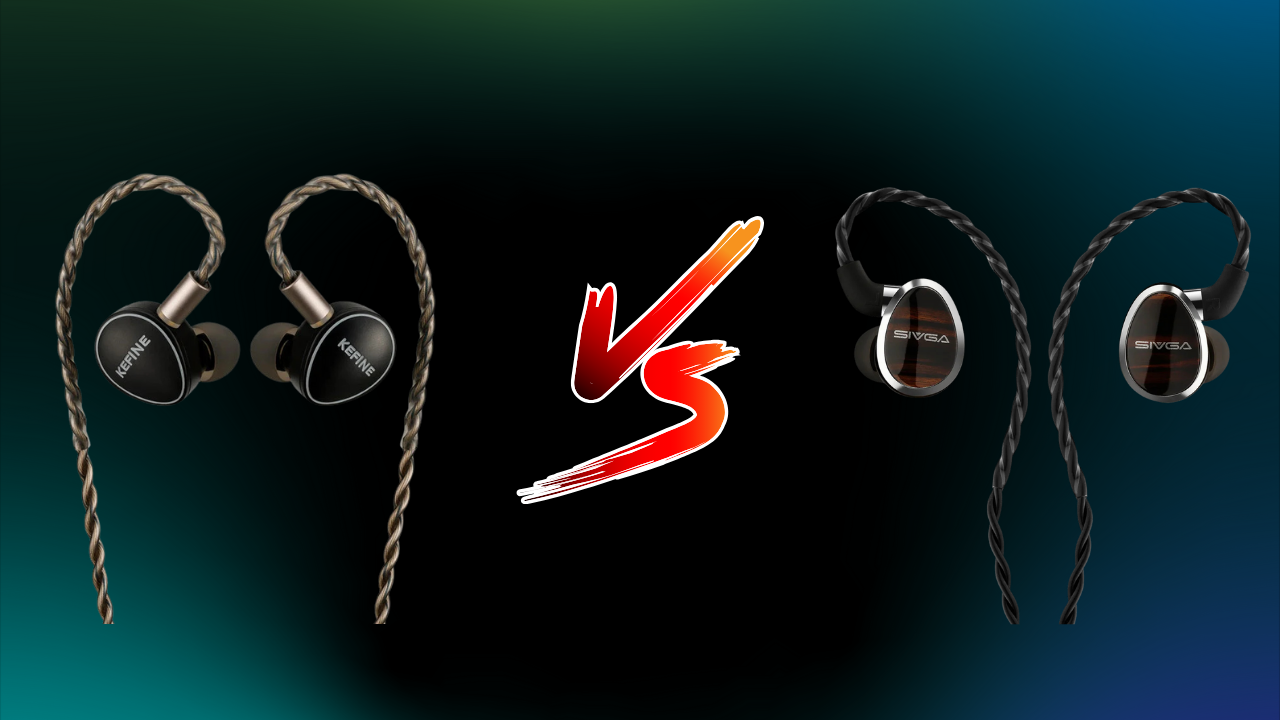
Explore how the budget-friendly Kefine Quatio and the planar-powered Sivga Nightingale compare in sound quality, design, comfort, and value. Find out which IEM delivers better clarity, imaging, and overall listening performance. In the increasingly competitive entry-level audiophile market, the Kefine Quatio and Sivga Nightingale represent two distinctly different approaches to high-fidelity in-ear monitoring. While both aim to elevate everyday listening beyond consumer-grade earbuds, their philosophies diverge significantly in driver design, tuning strategy, and sonic presentation. This makes them an ideal matchup for listeners deciding between hybrid and planar magnetic IEM technologies.
What You Get
| Quatio | Nightingale |
|
|
Look & Feel
The Kefine Quatio features CNC-machined aluminum housings that feel dense, durable, and far more premium than its price might suggest. By contrast, the Sivga Nightingale adopts a more artistic design approach. Its teardrop-shaped shells feature real wood accents, lending it a distinct identity rarely found at this price level. t. Despite their slightly larger shells, the Quatio sits comfortably in the ear and maintains a stable seal, allowing for extended listening sessions without discomfort. Isolation is excellent, making it well-suited for commuting or studio use alike. Its industrial aesthetic leans toward professional and understated rather than decorative.
The Nightingale is notably lightweight, which contributes to its exceptional comfort during long listening sessions. While it lacks the modular tuning features of the Quatio, its ergonomics and visual appeal make it one of the more striking IEMs in its class. Ultimately, both IEMs offer strong build quality and comfort, but they cater to different sensibilities. The Quatio will appeal more to listeners who prefer a rugged, professional feel with customization options, while the Nightingale caters to those who appreciate visual craftsmanship and lightweight elegance.
Design
At the heart of the Kefine Quatio is a hybrid quad-driver configuration consisting of two dynamic drivers and two balanced armatures. This design allows Kefine to distribute frequency responsibilities across specialized drivers, resulting in a sound that emphasizes clarity, balance, and adaptability. The interchangeable nozzles further allow listeners to adjust bass presence or treble openness depending on personal preference, making the Quatio highly versatile across genres.
The Sivga Nightingale, on the other hand, relies on a single large planar magnetic driver. Planar drivers are prized for their uniform diaphragm movement and natural coherence, often delivering a smoother and more spatially consistent sound than traditional dynamic or hybrid designs. Sivga’s choice reflects a desire to prioritize tonal cohesion and spatial realism rather than modular tuning. This difference in driver philosophy defines much of how these two IEMs sound. The Quatio aims to be a flexible, detail-oriented monitor, while the Nightingale seeks to deliver a cohesive, immersive musical experience.
Soundstage
In terms of spatial performance, both IEMs perform well but in different ways. The Kefine Quatio offers accurate imaging with strong left-to-right separation and a coherent soundstage that makes it easy to locate individual instruments. Its presentation feels stable and well-organized, making it an excellent choice for critical listening and monitoring. The Sivga Nightingale, benefiting from planar magnetic technology, delivers a soundstage that feels more expansive and layered. Its spatial presentation is more immersive, with greater depth and a sense of air between instruments, giving recordings a more three-dimensional quality. Those who value pinpoint accuracy and structure may prefer the Quatio, while listeners who enjoy a more enveloping and atmospheric soundstage may find the Nightingale more satisfying.
Low End
The Kefine Quatio’s bass response is highly dependent on the nozzle configuration selected. With the bass-enhancing nozzle installed, it delivers a fuller and warmer low end that adds punch and body without becoming overwhelming. Switching to a more neutral nozzle tightens the bass and emphasizes speed and texture instead. Across all configurations, the Quatio maintains good bass control, avoiding the bloated or muddy character often found in budget IEMs.
The Sivga Nightingale approaches bass with greater subtlety. Its planar driver delivers a low end that is more natural and restrained, favoring tonal balance over visceral impact. Rather than emphasizing slam or sub-bass extension, the Nightingale’s bass integrates seamlessly into the midrange, contributing to its musical and organic presentation. Listeners seeking adjustable bass response and stronger impact will likely gravitate toward the Quatio, while those who prefer a refined, natural low end that supports the music without dominating it may find the Nightingale more appealing.
Mids
Both IEMs excel in midrange performance, though their tonal characters differ significantly. The Kefine Quatio presents its mids with excellent clarity and separation, making it particularly effective for complex mixes and instrumental detail. Vocals sound balanced and clean, never recessed or artificially forward, and benefit from the Quatio’s strong imaging capabilities.
The Sivga Nightingale, by contrast, delivers a more organic and emotionally engaging midrange. Its planar driver gives vocals and acoustic instruments a richness and natural timbre that feels closer to a live performance. This makes the Nightingale especially satisfying for vocal-centric genres, jazz, and acoustic recordings where tonal authenticity is paramount. In essence, the Quatio excels in precision and neutrality, while the Nightingale shines in musical expressiveness and tonal beauty.
Highs
The Kefine Quatio maintains a controlled and smooth treble response that avoids harsh peaks or sibilance. While it does not emphasize sparkle or exaggerated air, it delivers enough high-frequency detail to preserve clarity without causing listener fatigue. This tuning makes it well-suited for long sessions and analytical listening alike.
The Sivga Nightingale offers a slightly more engaging treble presentation, with planar-driven smoothness that adds refinement and openness to the upper registers. Highs feel more spacious and natural, contributing to the Nightingale’s immersive character without sounding sharp or brittle. Listeners who prefer a relaxed, fatigue-free treble may lean toward the Quatio, while those who appreciate a more refined and airy top end will likely favor the Nightingale.
Summary
Choosing between the Kefine Quatio and Sivga Nightingale ultimately comes down to listening priorities rather than absolute performance, as both offer excellent value in the affordable audiophile segment. The Kefine Quatio is best suited for listeners who value versatility, tunable sound, and technical clarity. Its hybrid driver setup and modular nozzles make it a strong option for those who listen across multiple genres and enjoy tailoring their sound to different moods or recordings.
The Sivga Nightingale, by contrast, is ideal for those who prioritize musicality, natural timbre, and immersive spatial presentation. Its planar magnetic driver delivers a refined and emotionally engaging sound that particularly excels with vocals, acoustic music, and ambient recordings. Both are standout choices in their price range, and neither is objectively superior across all categories. Instead, they represent two distinct interpretations of what affordable high-fidelity IEMs can be, giving audiophiles compelling options regardless of their sonic preferences.
The Kefine Quatio and Sivga Nightingale are available at Audio46.
MAJORHIFI may receive commissions from retail offers.