
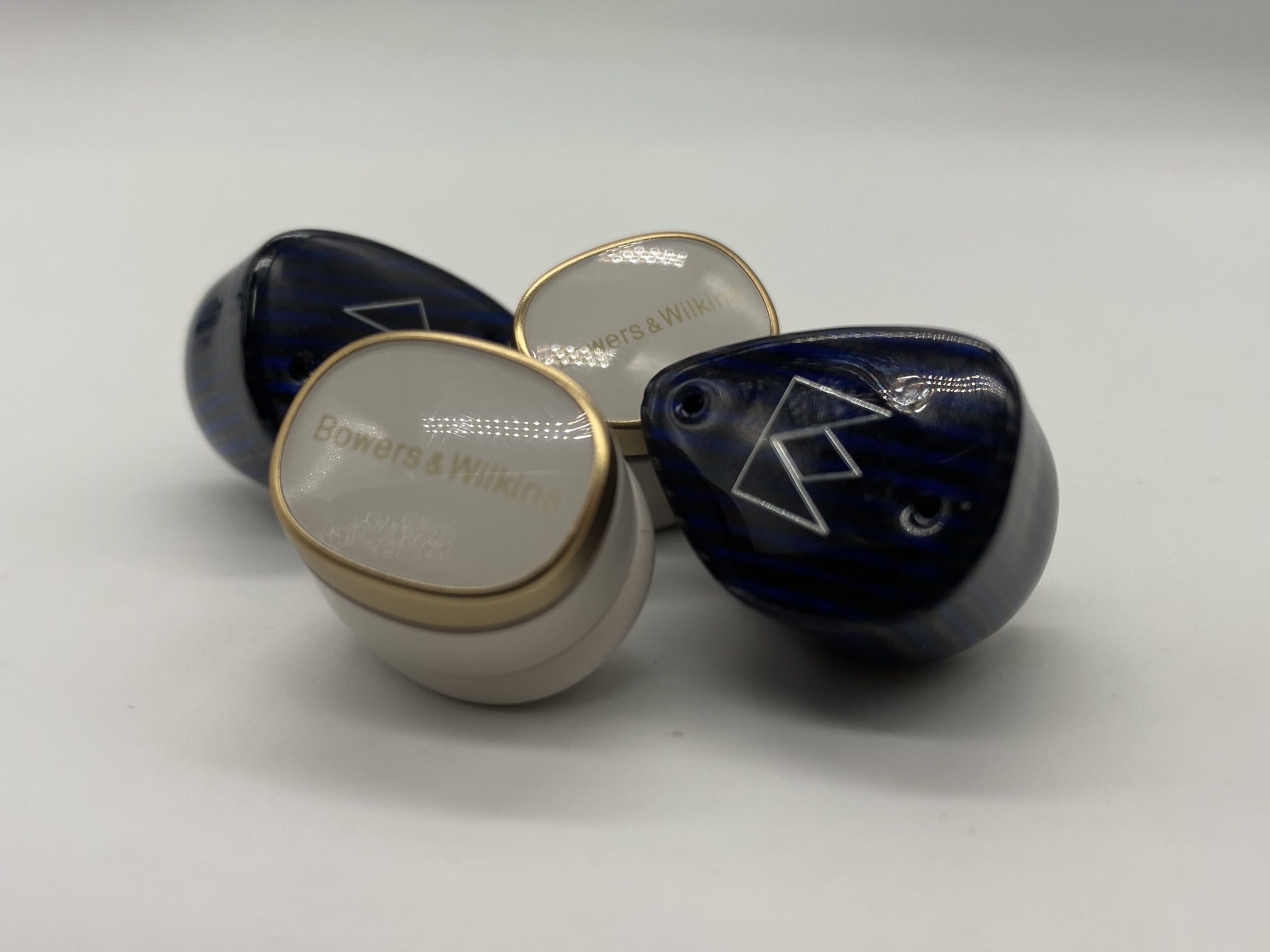
Wireless earbuds have never sounded as refined as they do today, especially at the premium end of the market. The Noble FoKus Prestige Encore and Bowers & Wilkins Pi8 both aim for audiophile-grade performance, but they take very different design and tuning approaches. In this in-depth comparison, we pit these two high-end true wireless earbuds against each other to help you decide which flagship pair is right for you.
What You Get
| Pi8 | Prestige Encore |
|
|
Look & Feel
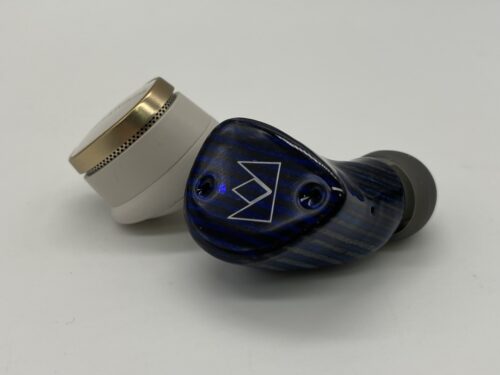
The Encore stands out immediately with its luxurious CNC-machined solid wood housing and charging case, giving each set a unique, handcrafted aesthetic that luxury audio fans will appreciate. The IEM-inspired shells feel more substantial and premium than most true wireless buds on the market, reinforcing their boutique appeal. Bowers & Wilkins opted for a sleek and minimalist design that’s lighter and more versatile. The Pi8’s form factor fits comfortably inside the ear with a classic earbud shape that’s easy to wear for extended sessions. Its understated elegance and choice of refined finishes make it fit easily into any daily carry. If you want a standout, artisanal look, the Prestige Encore wins. For a cleaner, everyday aesthetic with broad comfort appeal, the Pi8 takes the edge.

Design & Functionality
Behind the sound signatures of both the Noble FoKus Prestige Encore and Bowers & Wilkins Pi8 are thoughtfully engineered driver systems that reflect each brand’s sonic priorities. The Prestige Encore uses a hybrid driver configuration in each earbud, combining dynamic, balanced armature, and planar magnetic drivers in a custom-tuned crossover network. In contrast, the Pi8 employs a dual full-range transducer design with carefully calibrated acoustic chambers and driver tuning that emphasize coherence and musicality. Rather than blending multiple distinct driver types, Bowers & Wilkins focuses on extracting the maximum performance from each full-range driver, using the earbud’s physical design and tuning to shape the sound.
When comparing noise-canceling performance, both the Noble Audio FoKus Prestige Encore and the Bowers & Wilkins Pi8 deliver effective ANC, though their strengths manifest differently. The Prestige Encore benefits greatly from its IEM-style fit and strong passive isolation, which allows its active noise canceling to work more efficiently by reducing ambient sound before processing even begins. As a result, low-frequency noise such as engine hums and background rumble is suppressed convincingly, creating a quieter canvas that enhances critical listening.
The Pi8’s ANC is more overtly active in nature, designed to adapt dynamically to changing environments like commuting or walking through busy urban spaces. It does a strong job attenuating consistent environmental noise while maintaining a natural sense of pressure and balance, particularly when switching between ANC and transparency modes. While the Encore’s noise canceling feels more subtle and synergistic with its physical seal, the Pi8’s ANC comes across as more versatile and situationally responsive.
The Noble app provides fine-tuned EQ customization and onboard personalized sound calibration for tailored listening. Meanwhile, the Bowers & Wilkins Pi8 offers a robust 5-band EQ and TrueSound mode for tuning on the fly. In terms of controls, both the Noble Audio FoKus Prestige Encore and the Bowers & Wilkins Pi8 rely on touch-based interfaces, but they differ in execution and overall feel. The Prestige Encore uses responsive touch controls that are intentionally minimal, aligning with Noble’s audiophile-first philosophy. Basic functions such as play/pause, track navigation, and ANC toggling are handled reliably, though the layout prioritizes simplicity over extensive gesture customization.
Bluetooth
In terms of Bluetooth codecs and connection speed, both the Noble Audio FoKus Prestige Encore and the Bowers & Wilkins Pi8 position themselves firmly in the premium true wireless category, though with slightly different emphases. The Prestige Encore supports high-resolution Bluetooth codecs, including LDAC and aptX variants, allowing it to transmit more data and preserve detail for listeners using compatible source devices. Connection speed is solid and reliable, with pairing that feels deliberate rather than instant, but once connected, the signal remains stable and consistent, reinforcing the Encore’s focus on sound quality over rapid device hopping. The Pi8 also supports advanced codecs such as aptX Adaptive and aptX Lossless, giving it a strong advantage for users invested in Qualcomm-enabled devices.

Battery Life
Battery life can make or break the practical appeal of earbuds, and here the Prestige Encore holds a noticeable advantage. With ANC off, the Encore delivers up to 10 hours of continuous playback on a single charge, and around 7 hours with ANC enabled. Its charging case extends total uptime to approximately 35 hours. Quick charging on the Encore also offers a significant boost with just a few minutes of top-up. The Pi8, while respectable, offers roughly 6.5 hours per charge with ANC on and about 13.5 additional hours from the charging case, still solid but not quite at flagship endurance levels. Both options support USB-C and wireless charging (Pi8 only), making them convenient for daily routines, but those who prioritize long listening sessions without frequent charges will appreciate the Encore’s stamina.

Soundstage
When it comes to soundstage, the Noble FoKus Prestige Encore and Bowers & Wilkins Pi8 both deliver above-average spatial presentation for true wireless earbuds, but they differ in character. The Encore’s hybrid driver system and tuning emphasize a wide and expansive soundstage that often feels larger than most TWS competitors, creating a sense of openness that helps instruments appear spaced apart with convincing depth and imaging. This roomy stage enhances the perception of air around instruments and vocals, making orchestral pieces, jazz ensembles, or complex mixes feel more lifelike and immersive, a rare feat in the wireless category.
The Pi8 also projects a well-defined and holographic soundstage, with excellent lateral width and natural layering that allows instruments and vocals to sit neatly in the mix. While it may not feel quite as cavernous as the Encore’s presentation, the Pi8’s stage is consistently engaging and often feels more cohesive and balanced across genres, giving listeners a strong sense of scale without sacrificing clarity.
Low End
In the low frequencies, the FoKus Prestige Encore prioritizes control and texture over outright impact. Its bass response is tight and disciplined, delivering clean sub-bass extension without excessive bloom. Kick drums and basslines are rendered with clarity and definition, maintaining separation from the midrange even in dense mixes. This tuning allows the low end to support the overall presentation rather than dominate it. The Pi8, on the other hand, leans into a more authoritative and weighty low-end response. Its bass has greater physical presence and slam, giving electronic and modern pop tracks a sense of drive and momentum. While still controlled, the Pi8’s bass is more prominent in the mix, contributing to its warmer, more immediately engaging sound signature.
Mids
The midrange is where the philosophical differences between these two earbuds become most apparent. The FoKus Prestige Encore delivers mids with a neutral and transparent character, allowing vocals and instruments to sound natural and uncolored. There is a sense of openness and clarity that benefits acoustic recordings, strings, and vocal harmonies, with excellent separation between overlapping elements. The mids never feel recessed, but they also avoid excess warmth or forwardness. In comparison, the Pi8 presents a richer and more forward midrange, giving vocals a fuller body and emotional weight. This tuning brings singers and lead instruments closer to the listener, creating an intimate and expressive presentation that works particularly well for contemporary genres. While slightly less neutral than the Encore, the Pi8’s mids are inviting and musically satisfying.
Highs
High-frequency performance further reinforces each model’s identity. The FoKus Prestige Encore produces treble that is extended, airy, and finely detailed, contributing to its spacious soundstage and sense of realism. Highs are smooth and well-controlled, avoiding sharpness while still revealing subtle textures like cymbal decay and ambient detail. This treble tuning complements the Encore’s analytical strengths without sounding sterile. The Pi8 offers a slightly more energetic treble response, adding sparkle and clarity to the top end. Its highs bring liveliness to the presentation, enhancing perceived detail and excitement without becoming harsh. While not as airy as the Encore, the Pi8’s treble integrates well with its fuller low end and forward mids, maintaining balance across the frequency spectrum.
Summary
Both the Noble FoKus Prestige Encore and Bowers & Wilkins Pi8 set high bars for what premium true wireless earbuds can be in 2025. The Encore leans into audiophile precision, spatial immersion, and luxurious craftsmanship, while the Pi8 strikes a perfect balance of refined sound, useful features, and daily comfort. Your choice ultimately comes down to whether you favor reference-level fidelity or a rounded, everyday listening experience.
The Bowers & Wilkins Pi8 and the Noble FoKus Prestige Encore are available at Audio46.
MAJORHIFI may receive commissions from retail offers.