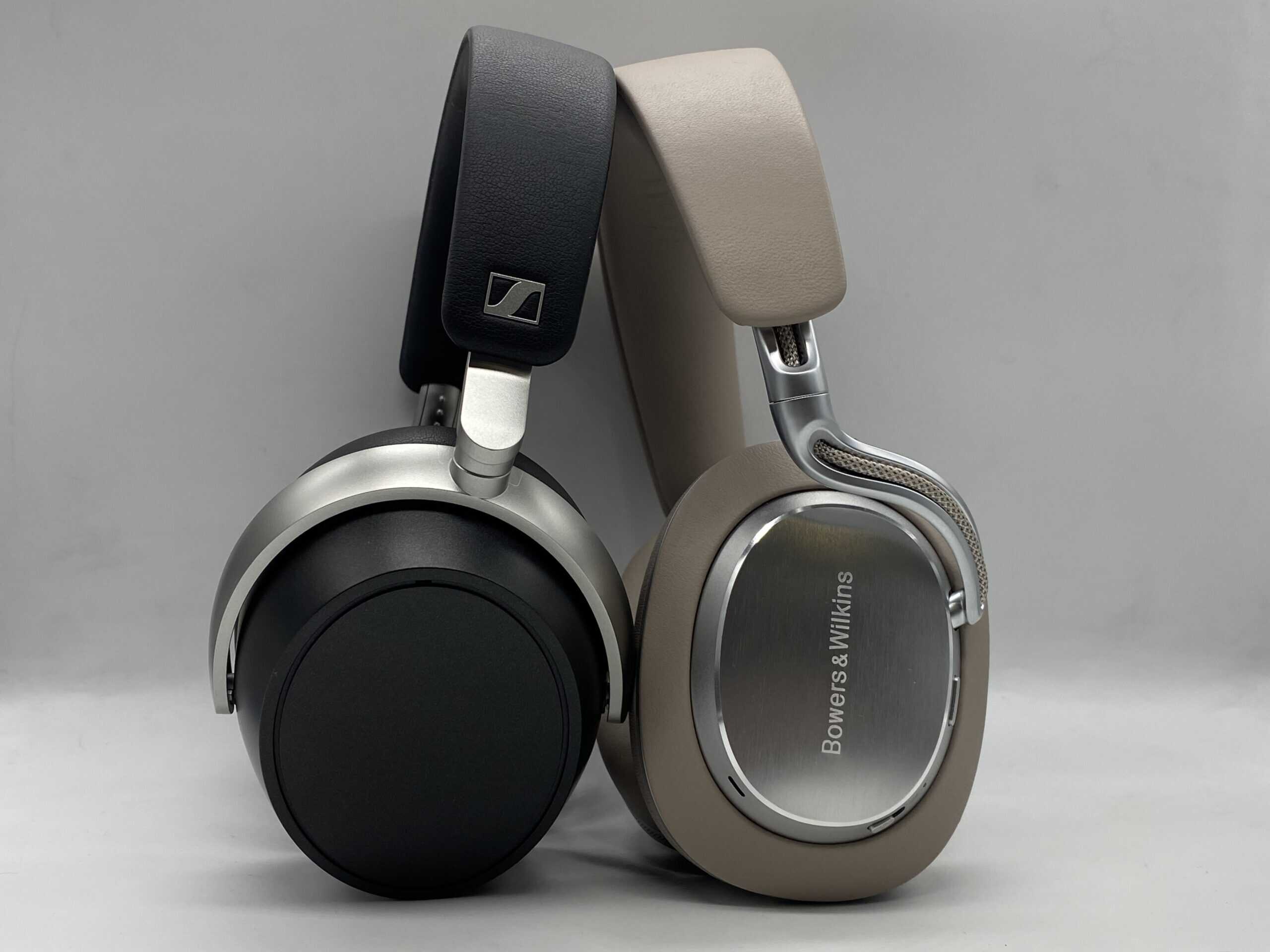
If you’re seeking top-tier wireless over-ear headphones for serious listening, two models stand out in 2025: the Sennheiser HDB 630 and the Bowers & Wilkins PX8 S2. Both aim to marry high-fidelity sound with modern wireless convenience, but they take somewhat different paths. This article pits them head-to-head on build & design, sound signature, features & connectivity, battery life, and value, to help you decide which best suits your needs.
What You Get
| HDB 630 | PX8 S2 |
|
|
Look & Feel
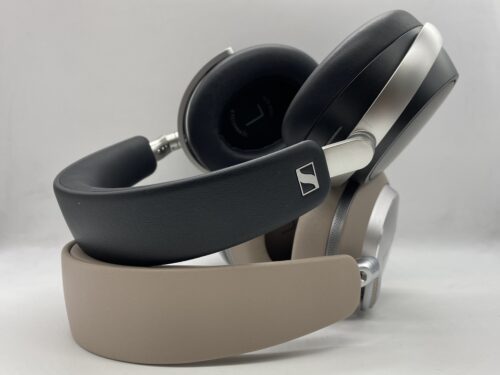
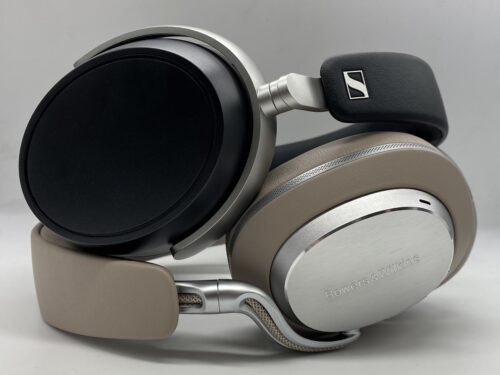
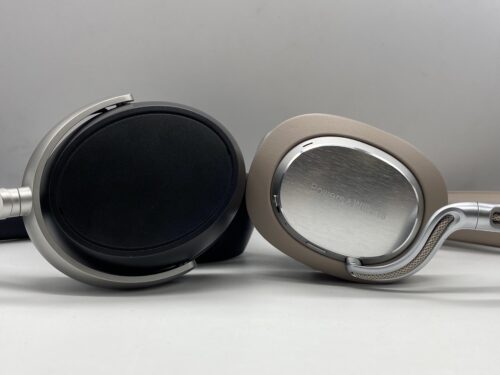
The Sennheiser HDB 630 maintains a refined, professional aesthetic reminiscent of Sennheiser’s Momentum line. It’s lightweight but solid, with plush padding and a controlled clamp force that balances isolation with comfort. It feels purpose-built for long listening sessions, whether in the studio or on the go. The Bowers & Wilkins PX8 S2, on the other hand, exudes luxury. Its aluminum frame, soft Nappa leather earcups, and sculpted arms immediately set it apart as a premium statement piece. Comfort is excellent overall, though it can run a bit warm during extended sessions. While both feel expensive, their design priorities differ. The HDB 630 opts for functional, audiophile practicality, while the PX8 S2 leans into style and high-end sophistication.
Design & Functionality
The Sennheiser HDB 630 employs a 42mm dynamic driver capable of reproducing audio up to 24-bit/96kHz when paired with the included BTD 700 USB-C dongle or used via wired connection. This allows listeners to experience true high-resolution playback without compromising on convenience. The Bowers & Wilkins PX8 S2 takes a slightly different approach with its proprietary 40mm Carbon Cone drivers, built around a custom 24-bit digital signal processor and dedicated amplifier system. The result is a sound presentation that emphasizes refinement and musicality.
When it comes to noise canceling, both models employ adaptive ANC systems but with different emphases. The HDB 630 features a four-microphone array that actively adjusts to environmental noise, maintaining a clean sound signature without adding noticeable pressure or hiss. Its transparency mode is equally refined, allowing external sounds to enter naturally when needed, a useful feature for commuting or working in mixed environments. The PX8 S2, by contrast, uses an enhanced eight-microphone system that delivers a slightly stronger degree of isolation. Its ANC is highly effective without compromising fidelity, keeping the focus squarely on musical accuracy rather than aggressive cancellation. The result is a listening experience that blocks out unwanted background noise while maintaining the open, dynamic sound Bowers & Wilkins is known for.
Control and app integration differ subtly between the two. The HDB 630 pairs with Sennheiser’s Smart Control Plus app, which offers detailed parametric EQ adjustments, A/B testing, and preset sharing. This level of control is ideal for users who enjoy fine-tuning frequency response for specific genres or listening environments. The PX8 S2, meanwhile, connects to the Bowers & Wilkins Music app, which provides a streamlined interface for ANC modes, basic EQ tweaks, and firmware updates.
Bluetooth
The HDB 630 packs modern connectivity through Bluetooth 5.2 with aptX Adaptive and aptX HD support. The included BTD 700 USB-C dongle enables 24-bit/96kHz wireless playback, a real advantage for listeners wanting near-lossless resolution. However, it lacks multipoint pairing and aptX Lossless support. The PX8 S2 uses Bluetooth 5.3 with support for aptX Lossless, Adaptive, and HD codecs. It’s designed for simple, high-quality streaming but omits advanced control features beyond its modest companion app, which provides limited EQ and ANC adjustment.
Battery Life
Battery performance is a decisive factor here. The HDB 630 offers an exceptional up to 60 hours of playback, easily lasting several days of heavy use. The PX8 S2, though solid, caps out around 30 hours, which is roughly half of Sennheiser’s endurance. If you’re often traveling or dislike frequent charging, the HDB 630 is the clear winner.
Soundstage
The Sennheiser HDB 630 has an impressively wide soundstage for a closed-back wireless headphone. It projects a “dome-like” spatial field that makes positioning easy to discern. Instruments feel naturally separated, and there’s a convincing sense of width that approaches a wired studio performance. The Bowers & Wilkins PX8 S2 delivers a similarly immersive experience but in a slightly different way. Its stage is intimate but precise, allowing for pinpoint accuracy in imaging. The PX8 S2 doesn’t open up quite as much as the HDB 630, but compensates with strong spatial depth and realism.
Low End
The HDB 630 keeps its bass controlled and tight, with a neutral tuning that avoids bloat. Sub-bass reaches low but doesn’t overpower the mix. It’s detailed, airy, and responsive — ideal for critical listening or music that demands balance and definition over sheer impact. The PX8 S2 takes the opposite approach. Its low end is bold, rich, and textured. Kick drums punch with more authority, and basslines have satisfying body. It’s musical and engaging, but a touch more colored than the HDB 630’s reference-like presentation.
Mids
Midrange response on the HDB 630 is smooth and full-bodied, with excellent clarity in vocals and acoustic instruments. It gives mixes a lifelike presence without coloration, making it especially appealing for studio monitoring or ambient and classical genres. The PX8 S2 has a cleaner, slightly scooped midrange that allows the bass and treble to stand out. Vocals remain clear, though they don’t occupy center stage as prominently as on the Sennheiser. It’s a refined, polished tone that prioritizes fluidity over raw neutrality.
Highs
The HDB 630’s treble is crisp and detailed, with refined brightness that adds sparkle without harshness. Highs feel open and airy, enhancing imaging and instrument separation. The PX8 S2 maintains a smoother top end. Treble notes have a pleasing clarity but are slightly softer, creating a more relaxed and non-fatiguing listen. Cymbals shimmer naturally but never verge into sibilance.
Summary
MAJORHIFI may receive commissions from retail offers.