
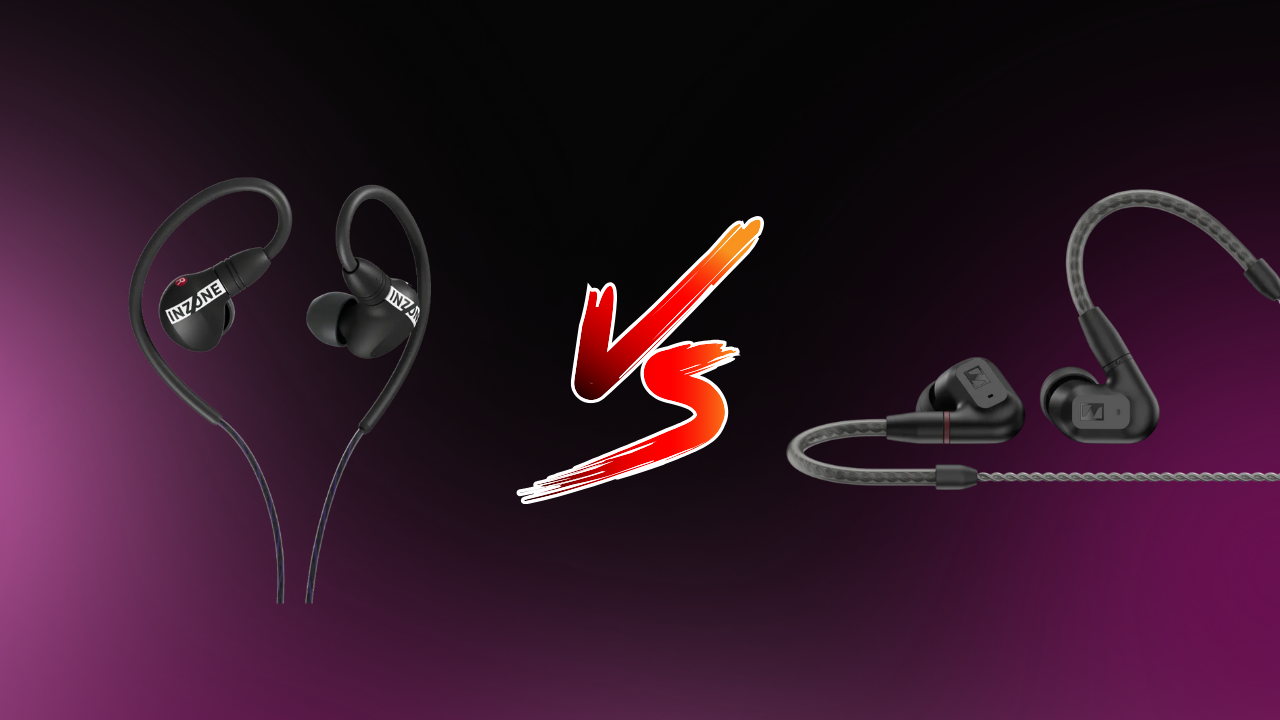
In-ear monitors have become increasingly specialized over the last few years. Some are tuned specifically for competitive gaming, prioritizing positional accuracy and clarity, while others focus on musical balance and tonal refinement for everyday listening. The Sony INZONE E9 and the Sennheiser IE 200 sit at two very different points on that spectrum. The INZONE E9 is built with esports in mind, engineered to deliver precise spatial cues and articulate midrange detail for competitive advantage. The IE 200, on the other hand, continues Sennheiser’s long-standing commitment to natural tonality and accessible audiophile performance. Comparing these two reveals not just different tuning philosophies, but two completely different listening priorities.
What You Get
| INZONE E9 | IE 200 |
|
|
Look & Feel
The Sony INZONE E9 has a lightweight, practical design that feels purpose-built for long gaming sessions. Its shells are compact and ergonomic, sitting securely in the ear without excessive pressure. The aesthetic is understated and functional rather than luxurious, aligning with its performance-first approach. It’s designed to disappear while you focus on gameplay. The Sennheiser IE 200 follows a more classic audiophile design language. The housings are compact and extremely lightweight, with a shape that contours naturally to the ear. The braided cable feels flexible and durable, and the overall build carries a slightly more premium impression. While minimal in appearance, it has the polish you expect from a Sennheiser product aimed at music listeners.
Design
Both IEMs use dynamic drivers, but the INZONE E9 has a more specific configuration tuned specifically for competitive gaming scenarios. The IE 200’s 7mm TrueResponse driver is more in line with the same driver philosophy found in Sennheiser’s higher-end IE series. Unlike the gaming-centric E9, the IE 200 aims for tonal balance across the frequency spectrum. Its compact driver size allows for a small housing design while maintaining impressive clarity and cohesion. In terms of drivability, both IEMs are efficient and easy to power. However, the IE 200 benefits from scaling with higher-quality DACs and portable amplifiers, while the E9 is clearly designed to operate optimally within Sony’s USB-C gaming ecosystem.
Soundstage
The Sony INZONE E9 presents a soundstage that prioritizes directional imaging over expansiveness. The Sennheiser IE 200 delivers a more natural and cohesive soundstage. It doesn’t exaggerate width, but it offers convincing separation and air between instruments. Imaging feels precise without being clinical, and the presentation maintains a musical sense of space rather than analytical sharpness. You get a slightly more spatial presentation with the INZONE E9, engineered for front-back and left-right positioning rather than immersive width. When paired with Sony’s spatial processing, it becomes particularly effective at placing sound cues accurately in competitive titles. The stage is not especially deep or atmospheric for music, but it excels in tactical awareness.
Low End
The INZONE E9 keeps bass controlled and relatively restrained, while the IE 200 offers a more balanced and satisfying low end. With the E9, Sub-bass presence is moderate, and mid-bass impact is tight rather than punchy. Meanwhile, the IE 200’s lows are more articulate and controlled, with enough presence to give body to drums and bass lines without overwhelming the mix. It avoids excessive bloom while still providing musical engagement. There’s a lack of weight to the INZONE E9 compared to the IE 200, but it’s a sound tuned more specifically for competitive gaming rather than gratifying immersion.
Mids
Midrange clarity is where the Sony INZONE E9 shows more vigor over the IE 200. Vocals and critical in-game sound cues are presented forward and clean, making dialogue and environmental sounds easy to isolate. The tuning emphasizes intelligibility, which directly benefits gaming performance. The IE 200’s midrange is more natural and smoother in comparison. Vocals sit comfortably within the mix rather than being aggressively forward. There’s a pleasing sense of tonal accuracy that makes acoustic instruments and vocals feel realistic and uncolored.
Highs
Whether you like crisp or controlled highs will be a big indicator of which IEMs you might prefer. The INZONE E9 does a good job of highlighting audio cues through its brightened treble. It provides strong detail retrieval, though at times it can feel slightly sharp depending on the source and volume. That brightness serves its competitive purpose but can lean analytical in casual listening. The IE 200 is a bit more balanced and relatively clean in timbre. Treble detail is present without becoming harsh, and there’s a smoothness that contributes to fatigue-free listening sessions.
Summary
The Sony INZONE E9 and Sennheiser IE 200 represent two distinct approaches to in-ear monitor design. The INZONE E9 is a focused, competitive gaming IEM built around clarity, imaging precision, and esports utility. The IE 200 is a balanced, musical earphone designed for natural tonality and everyday listening. If your primary goal is competitive advantage and positional awareness in FPS titles, the INZONE E9 is the more strategic choice. If you’re looking for a well-rounded IEM that delivers musical balance and versatility across genres, the IE 200 will likely be the more satisfying long-term companion. Both excel, but in entirely different arenas.
The Sony INZONE E9 and the Sennheiser IE 200 are available at Audio46.
MAJORHIFI may receive commissions from retail offers.