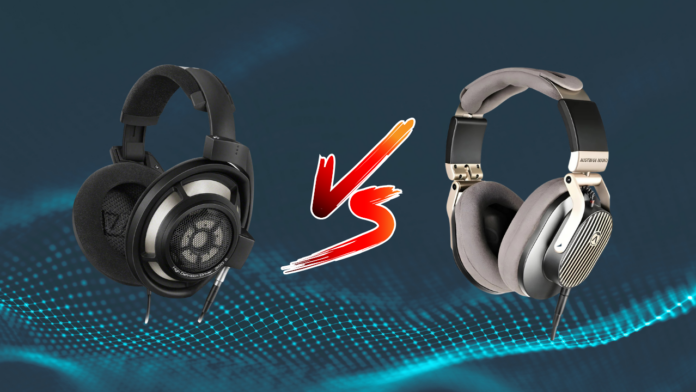
If you’re shopping for a flagship open-back headphone, two models stand out for listeners who want serious technical performance without sacrificing musicality: the legendary Sennheiser HD 800 S and the newer Austrian Audio The Arranger. One is a longtime benchmark known for enormous soundstage and precision. The other is a fresh contender built around studio-grade neutrality with a more approachable everyday tuning. Both target discerning audiophiles, but they go about it in very different ways.
What You Get
| HD 800 | The Arranger |
|
|
Look & Feel
The HD 800 S remains one of the most recognizable headphones ever made. Its oversized ear cups, industrial chassis, and angled driver design still feel futuristic years after release. It is also notably lightweight for a flagship model, which helps make it one of the easiest premium headphones to wear for hours. Reviewers still cite comfort as one of its defining strengths. The Arranger takes a more contemporary route. It feels sturdier and more compact, with premium materials and a studio-minded construction that seems built for regular use rather than pedestal display. It lacks the dramatic visual identity of the Sennheiser, but it makes up for that with practicality and understated elegance. In terms of comfort, few headphones compete with the HD 800 S. The enormous pads, low clamp force, and generous ear cavity make it feel almost speaker-like on the head. For marathon listening sessions, it remains elite. The Arranger offers a firmer, more secure fit. Some users may actually prefer that over the lighter clamp of the HD 800 S, especially if they move around while listening. It feels more grounded, while the Sennheiser feels more floating and spacious.
Design
The Sennheiser HD 800 S uses Sennheiser’s signature 56mm ring radiator dynamic driver, a design long associated with the headphone’s flagship status. Rather than using a conventional dome-style diaphragm, the ring radiator structure helps reduce modal breakup while increasing speed and control across the frequency range. The Austrian Audio The Arranger uses Austrian Audio’s in-house Hi-X dynamic driver platform, developed around the company’s focus on low distortion, speed, and reference monitoring accuracy. One of the obvious aspects of these headphone designs is their competing impedances. HD 800 S buyers should be aware of its high resistance, which requires a good headphone amplifier. With the Arranger, a headphone amplifier is still recommended, but it isn’t as necessary.
Soundstage
This is where the HD 800 S earns its reputation. Even years later, it remains one of the widest and most holographic headphones available. Instruments feel separated by real space rather than simply panned left and right. Even centered mixes are presented with noticeable dimensionality, making it one of the strongest options for listeners who value scale, separation, and positional cues. The Arranger has a convincing open presentation too, but it is more intimate and realistic rather than cinematic. Instead of stretching everything outward, it focuses on coherence and believable placement. Its imaging appears more studio-oriented, prioritizing clean placement and believable proportions over sheer expansiveness. That makes it a stronger option for listeners who want precision without an overly diffuse presentation.
Low End
The HD 800 S bass is fast, articulate, and disciplined. It prioritizes texture and timing over slam. For orchestral music or acoustic recordings, this can sound wonderfully clean. For bass-heavy genres, some listeners still find it restrained. It is highly detailed, fast, and coherent, with strong transient definition rather than heavy impact. The Arranger delivers more satisfying low-end presence. It reaches deeper and feels more natural with modern pop, electronic music, rock, and hip-hop. It doesn’t become bloated, but it adds welcome body. Rather than emphasizing strict linearity alone, it appears tuned to retain accuracy while giving music stronger physicality and engagement.
Mids
Midrange on the HD 800 S is transparent and spacious. Vocals and instruments emerge cleanly with lots of air around them, but some listeners may perceive it as slightly clinical. The HD 800 S is pristine, clear, and spacious, with excellent layering and room for instruments to breathe. Vocals are present without sounding pushed forward, helping preserve the headphone’s reference identity. The Arranger counters with denser note weight and a more emotionally direct midrange. Vocals feel fuller, and guitars have stronger harmonic richness. If you want a connection over distance, the Arranger has the edge, balancing neutrality with warmth and listenability.
Highs
The HD 800 S treble is famous for revealing detail and atmosphere. It can expose micro-information effortlessly, but source matching matters. It offers sparkle, headroom, and excellent detail retrieval while remaining more controlled than the original HD 800. This contributes heavily to its sense of air and spaciousness. The Arranger still resolves well, but with a smoother and more forgiving top end. It is less likely to punish bright masters or harsh recordings. It preserves detail while aiming for long-session comfort and broader compatibility with everyday listening.
Summary
The Sennheiser HD 800 S is still a specialist masterpiece: huge stage, razor imaging, airy treble, and elite detail. The Austrian Audio The Arranger is the more versatile modern tuner: fuller bass, richer mids, smoother highs, and easier day-to-day enjoyment. If you want to study recordings, choose the HD 800 S. If you want to live with one flagship every day, choose The Arranger.
The Sennheiser HD 800 S and the Austrian Audio Arranger are available at Audio46.