Absynth has always occupied a strange and fascinating space in the world of software synthesizers. Rather than chasing classic analog emulation or straightforward electronic production sounds, it has built its reputation around evolving textures, abstract timbres, cinematic atmospheres, and sounds that feel like they are constantly shifting under the surface. With Absynth 6, Native Instruments brings that identity into a more modern workflow, updating the interface while keeping the synth’s experimental spirit intact.
For producers, composers, and sound designers looking for something outside the usual virtual instrument toolkit, Absynth 6 presents itself as both an instrument and a deep creative processor. Its combination of hybrid synthesis, morphing textures, extensive modulation, and unusual effects makes it especially appealing for ambient music, film scoring, game audio, and experimental production. Let’s dive into Absynth 6 from the perspective of a first-time Absynth user, exploring how approachable it feels, how inspiring its preset system can be, and how far its sound-design possibilities can go.
What Is Absynth 6?
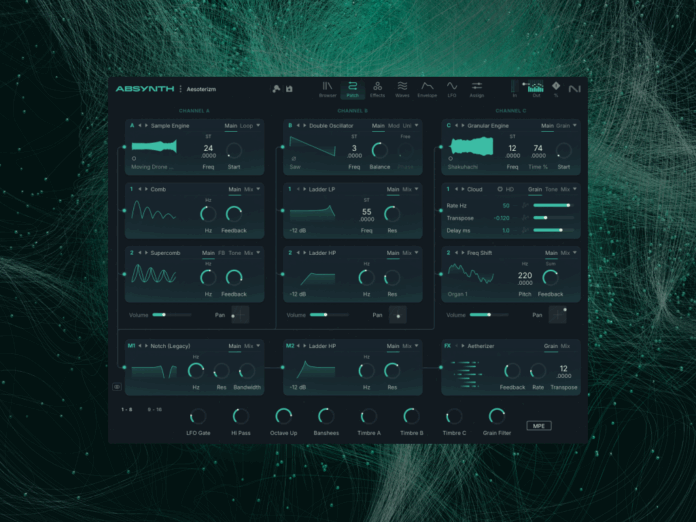
Absynth 6 is a semi-modular software synthesizer built for experimental sound design, evolving textures, atmospheric pads, and complex cinematic tones. Its hybrid synthesis engine combines granular, FM, wavetable, subtractive, granular sampling, and wave-morphing across three oscillator channels, giving users a wide range of ways to build sounds from the ground up. Absynth 6 also includes a deep modulation system, detailed multi-point envelopes, dedicated LFOs, and creative effects like Aetherizer and Cloud Filter, making it especially useful for shaping movement, space, and unpredictable sonic character. With more than 2,000 presets, over 350 new Factory Library sounds, backward compatibility with older Absynth patches, surround support, MPE and polyphonic aftertouch integration, and a Preset Explorer/Mutator workflow, Absynth 6 is designed to be both a deep sound-design instrument and an accessible source of ready-to-use tones.
Hands-On Impressions
This section should be prefaced by saying that I have never used any previous version of Absynth before Absynth 6. I’ve taken a look at Absynth 5, and just from a glance, Absynth 6 is a major overhaul of its GUI. However, the essence of that synth seems to be intact, with a similar patch and LFO interface that’s been spruced up and modernized for Absynth 6. As someone who isn’t as familiar with Absynth before Absynth 6, opening up this virtual instrument for the first time can be a bit daunting. While I’ve had experience with virtual synths before, like Vital, Absynth is a whole different, weirder beast.
My time with Absynth 6 can be split up into two different experiences. There’s Absynth as an instrument for composition, and Absynth as an effects plug-in. My DAW is Pro Tools, which allowed me to attach Absynth 6 to a MIDI track, as well as render it using Audio Suite. With its many effects, wave shapers, and filters, Absynth 6 quickly became my sound design machine. That is, after spending a significant amount of time learning the ropes and making everything work for me.
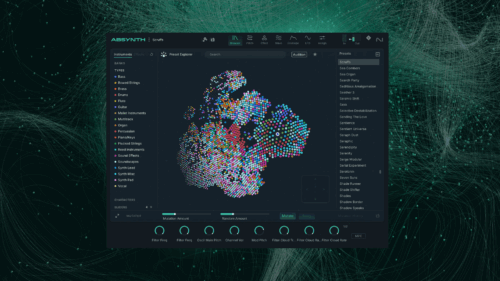
When you first open up Absynth 6, you’re met with its preset browser, which defaults to this enormous map that acts as a network linking all of these sounds. To simplify any broader analysis of it, Absynth 6’s preset map is really cool. It’s very easy to get lost clicking around to try out all the sounds you can explore, all of which are completely adjustable via the patch window or Absynth’s Mutator. All of these presets are organized into categories such as pads, drums, bass, and more. Clicking on the sidebar highlights all of these sounds on the map, greying out all other nodes not affiliated with your selections. If you use the arrow keys, you can jump around the map quickly auditioning each sound.
If you’re a beginner, you will definitely spend a ton of time sorting through these presets and choosing favorites, which Absynth allows you to do by starring what you like. Going through these presets myself, I noticed a trend. Nothing here resembles commonly used synths, so if you’re looking for a VST that will emulate your favorite old school synthesizer, you might be disappointed. However, Absynth 6 may allow you to come up with something close using patches, which can be intimidating at first, but once you’re over the learning curve, Absynth is really able to show you how creative a sound designer you can be. This works for both music and sound effects, as Absynth has almost limitless capabilities for how much you can warp audio. That’s what I hear with a lot of these presets. They all have a variety of authors, including ones you may recognize, like Brian Eno. Everything sounds fresh and customizable just through Absynth 6’s tools. All of this encourages you to be more experimental, where it’s less about how Absynth can work for you, and rather what you can bring to Absynth.
Whether you start from square one with a new patch or use the framework from a preset, Absynth 6 gives you authorship over your sounds and encourages you to get abstract. I’ve made out Absynth 6 to be a limitless sound design tool, but I should emphasize the word almost. There’s one thing that puts a creative block on your sound, at least within Absynth 6 itself. You’re only allowed one effects path, which puts a barrier on experimentation a bit. I kept navigating through the effects panel, trying to figure out how I can hear my patch with Aetherizer and Pipe at the same time, but there is no such way to do it. This is a minor nitpick when set up against everything Absynth 6 can do, though, as even just putting an effect like Aetherizer on a single oscillation patch can sometimes make for some immense atmospheric and cinematic textures.
Should You Purchase Absynth 6?
Absynth 6 is not the kind of synth you open when you want a quick analog bass, a familiar vintage lead, or a simple bread-and-butter keyboard sound. Its strength is in the opposite direction. This is a software synthesizer built for producers and sound designers who want to discover sounds rather than simply dial them in. Its preset browser, Mutator workflow, hybrid synthesis engine, and atmospheric effects make it easy to fall into experimentation, while its deeper patching and modulation tools offer plenty of room for more deliberate sound creation.
There is definitely a learning curve, especially for users coming to Absynth for the first time. The interface may be cleaner and more modern than previous versions, but Absynth 6 still has its own internal logic, and getting the most out of it requires patience. The single effects path also feels slightly limiting, considering how much the synth encourages experimentation. Still, those limitations do not take away from what makes Absynth 6 so compelling. As a cinematic texture generator, ambient pad machine, experimental synth, and creative effects processor, Absynth 6 remains one of the more distinctive instruments in Native Instruments’ lineup. For anyone looking to add movement, atmosphere, and unpredictability to their productions, Absynth 6 is an inspiring tool with a sound that feels genuinely its own.
You can check out purchasing options for Absynth 6 from Native Instruments.