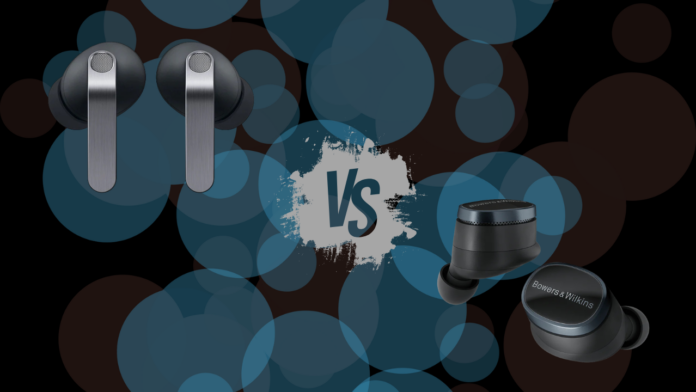
Premium true wireless earbuds have reached a point where it’s no longer enough to offer good noise canceling and convenient Bluetooth performance. The best earbuds in this category now need to deliver a complete experience, balancing comfort, app features, codec support, battery life, and sound quality that can satisfy more than just casual listeners. Two models that aim for this upper tier are the Samsung Galaxy Buds 4 Pro and the Bowers & Wilkins Pi8. Samsung’s Galaxy Buds 4 Pro are built around a modern mobile ecosystem, especially for Galaxy phone users who want seamless pairing, strong ANC, spatial audio, and smart features in a compact everyday design. The Bowers & Wilkins Pi8 takes a slightly different approach, leaning more into premium audio performance with carbon cone drivers, aptX Lossless support, and a more hi-fi-inspired sound signature. Both are flagship wireless earbuds, but they appeal to slightly different listeners.
What You Get
| Galaxy Buds 4 Pro | Pi8 |
|
|
Look & Feel
For comfort, the Galaxy Buds 4 Pro are likely the easier pick for most people. The stem-style design feels like Samsung’s answer to the modern AirPods-style form factor. They use a pod-shaped ear cavity with a thin stem that helps them sit securely in the ear without feeling like they’re just hanging there. The fit is comfortable and practical, making them easy to wear for commuting, work, or casual listening. Their design feels more functional than luxurious, but that works in their favor as a daily-use earbud. The Bowers & Wilkins Pi8 makes a stronger visual statement. Compared to past B&W true wireless models, the Pi8 has a redesigned shell that better reflects the brand’s classy aesthetic. The finish has more shine and personality, especially in colors like midnight blue and jade green. However, the fit is more demanding. Like other Bowers & Wilkins earbuds, the Pi8 requires a slight twist to seat properly in the ear. Once placed correctly, the fit is snug, but it can become fatiguing after longer listening sessions. However, for style and premium looks, the Pi8 has the edge.
Design & Functionality
Samsung wins on smart features and usability, especially for Galaxy users. Bowers & Wilkins wins on driver design and a more premium audio-first approach. They give the Galaxy Buds 4 Pro a feature set built for everyday convenience. They use dual 2-way speakers and active noise cancellation, along with AI-powered features like live translation and smart voice assistance when paired with compatible Galaxy devices. Their IP57 water and dust resistance also gives them more durability for daily use, workouts, and travel. The controls are one of their most satisfying design choices, using a pinch-style stem press instead of overly sensitive touch gestures. This makes playback and ANC adjustments feel more deliberate and less prone to accidental inputs. The Bowers & Wilkins Pi8 focuses more on audio hardware. Its carbon cone drivers are a major upgrade from previous Pi-series earbuds, giving the Pi8 more headroom, stronger drive, and a more refined sound. The touch controls are also responsive, and the app allows for control customization along with noise canceling and passthrough adjustments. ANC performance is strong here as well, giving the Pi8 a competitive place among premium noise-canceling earbuds.
For ANC alone, both are strong, but the Galaxy Buds 4 Pro feel like the more practical daily option. The Galaxy Buds 4 Pro deliver very strong active noise cancellation. Their isolation is close to what you get from top-tier competitors, making them a reliable choice for commuting, office use, and general travel. Samsung’s ANC also pairs well with the earbuds’ secure fit, helping them block distractions without needing an overly bulky design. The Pi8 also offers strong noise canceling, and it competes well with many of the best earbuds on the market. Its ANC is simple and effective, with passthrough controls available in the app. However, Samsung’s overall noise-canceling experience feels a bit more integrated into the full user experience, especially when combined with its mobile ecosystem and easy controls.
Bluetooth
Bluetooth performance is one of the clearest differences between these earbuds. The Samsung Galaxy Buds 4 Pro use Bluetooth 5.3 and are built around seamless integration with Samsung Galaxy devices. They support Samsung’s proprietary Seamless Codec, which allows higher-quality wireless playback when used with compatible Galaxy smartphones. Auto Switch also makes them especially convenient for users already in the Samsung ecosystem. The Bowers & Wilkins Pi8 has the more audiophile-friendly codec support, with aptX Lossless available through compatible devices. It also supports multipoint connection, making it easier to pair with more than one device. However, the Pi8 review notes some sync issues and occasional dropouts, which slightly undercuts its otherwise strong codec advantage. The Galaxy Buds 4 Pro are better for consistent connectivity and Galaxy device integration. The Pi8 is better for listeners who specifically want aptX Lossless and have a compatible source device.
Battery Life
Neither earbud is class-leading for battery life, but Samsung has the advantage thanks to stronger total case endurance and slightly better everyday practicality. They offer up to 7 hours of playback on a single charge, with the case extending total listening time to around 30 hours depending on ANC and volume levels. With ANC on, real-world battery life is closer to 6 hours, which is solid for a premium true wireless earbud. The Bowers & Wilkins Pi8 gets around 6.5 hours from a single charge. The case supports fast wired and wireless charging, but the overall battery performance isn’t a major upgrade compared to other true wireless earbuds, especially considering the Pi8’s premium price.
Soundstage
The Galaxy Buds 4 Pro offer an impressively wide soundstage for true wireless earbuds. The presentation is mostly linear, but there is a strong left/right spread that gives instruments a clear sense of separation. Imaging is accurate, and the stereo field feels larger than expected for earbuds in this category. The Bowers & Wilkins Pi8 goes a step further. Its soundstage feels closer to what you might expect from a good pair of IEMs, with a larger sense of scope and more precise spatial imaging. Vocals sit forward, while instruments spread across the stereo field with more definition and separation. Both earbuds have strong staging, but the Pi8 feels more spacious and technically refined.
Low End
Samsung offers the more immediately fun bass response, while the Pi8 offers the more refined and textured low end. The Galaxy Buds 4 Pro have one of the stronger bass responses you’ll hear from a pair of true wireless earbuds. The bass has depth, body, and rumble, but it doesn’t always overwhelm the sound signature. When a track calls for restraint, the Buds 4 Pro can keep the low end controlled, but when the bass needs to hit, it has a smooth and gripping presence. There’s a Harman-like quality to the tuning that makes the bass feel both accessible and satisfying. The Pi8 also has a boosted low end, but its bass has a more organic bloom. Compared to older Bowers & Wilkins true wireless models, the Pi8 sounds less bloated and more refined. Its bass is thick, textured, and consistently felt underneath the mix, giving tracks a more physical sense of weight. The Pi8’s low end is still powerful, but it feels more mature and detailed.
Mids
For vocal clarity and midrange fullness, the Pi8 has an advantage. Overall, it has a fuller and more transparent midrange. Compared to many true wireless earbuds that lean heavily into a V-shaped sound, the Pi8 gives the mids more body and organization. Chaotic tracks come across more controlled, with notes sounding more physical and better separated. This is where the Pi8 starts to feel like the more audiophile-oriented earbud. The Galaxy Buds 4 Pro have a surprisingly natural midrange. Instruments have good tonality, and transients come through with nice precision. The mids are not the fullest or most resolving in the true wireless category, and some dips keep them from sounding especially rich, but they still avoid feeling thin or overly recessed. For everyday listening, the midrange is clean, flavorful, and easy to enjoy.
Highs
The Galaxy Buds 4 Pro have a smooth and delicate treble response. The highs don’t extend very far, but they have enough texture and gloss to add sparkle without becoming harsh. Their treble is light, clean, and easy to listen to, making the Buds 4 Pro a safe choice for long sessions. The Pi8 also has a gentler high-end response, but it brings a bit more crispness and detail to vocals and resonant textures. The highs are not the most dominant part of the sound signature, but they add a smooth sparkle that complements the fuller mids and detailed bass. The Pi8 sounds more refined in the highs, while the Galaxy Buds 4 Pro sound softer and more relaxed.
Summary
Choosing between the Samsung Galaxy Buds 4 Pro and Bowers & Wilkins Pi8 comes down to what kind of listener you are. If you want the best all-around wireless earbud for daily use, especially with a Samsung Galaxy phone, the Galaxy Buds 4 Pro are the stronger pick. They offer better convenience, dependable ANC, a more accessible fit, and a feature set that feels built for modern mobile listening. If sound quality is your main priority, the Bowers & Wilkins Pi8 makes a stronger impression. They deliver a bigger soundstage, fuller mids, more detailed bass, and a more premium sonic character that separates them from most true wireless earbuds. They are not as practical as the Galaxy Buds 4 Pro, but they are more rewarding for critical listening. For most users, the Galaxy Buds 4 Pro are the better everyday earbuds. For sound-focused listeners, the Bowers & Wilkins Pi8 is the more impressive listen.
The Samsung Galaxy Buds 4 Pro is available on Amazon, and the Bowers & Wilkins Pi8 is available at Audio46.