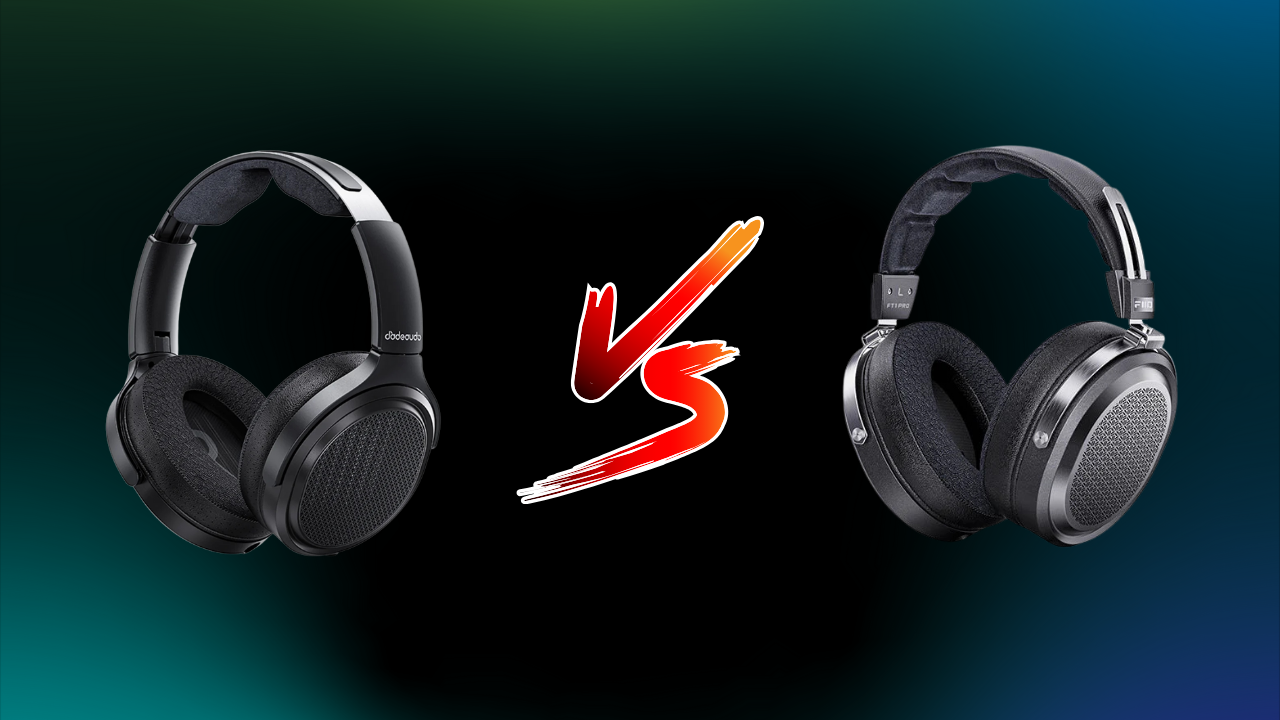
Planar magnetic headphones have long been celebrated for their exceptional clarity, wide soundstage, and refined detail retrieval, but these qualities once came with a steep price tag. In recent years, products like the Fiio Jade Audio JT7 and Fiio FT1 Pro have helped bring open-back planar performance into a much more attainable price range. Both headphones promise the expansive imaging and musicality that planar drivers are known for, but they take slightly different approaches to execution. Let’s break down how the JT7 and FT1 Pro stack up in terms of design, comfort, sound quality, and value to help you choose the right model for your listening habits.
What You Get
| JT7 | FT1 Pro |
|
|
Look & Feel
When it comes to physical design and comfort, both planar headphones feel well-constructed, but they differ in how they approach wearability over extended listening sessions. The Fiio JT7 catches your eye with a modern, foldable design that feels surprisingly portable for an open-back planar headphone. Its lightweight frame and plush ear pads reduce listener fatigue, making it easy to wear for hours without discomfort. The flexible, fold-in earcups are a particularly nice feature for anyone who plans to take the JT7 on the go, or for listeners who simply prefer a more adaptable fit. The open-back design also promotes airflow, which not only enhances comfort but also contributes to a more natural, breathable sound.
In contrast, the FT1 Pro opts for a more traditional open-back aesthetic. While its steel slide rails and fixed earcups don’t fold in like the JT7’s, the build quality feels reassuringly solid. The ear pads are generously cushioned and maintain comfort over long sessions, though some listeners with larger ears may find them slightly more snug than those on the JT7. While the FT1 Pro might not have the same travel-friendly ergonomics, it delivers a dependable, classic headphone feel that many desktop listeners will appreciate.
Design
In the case of the Fiio JT7 and the FT1 Pro, both use large planar magnetic drivers, but the tuning and execution differ in meaningful ways. The JT7’s diaphragm and magnetic array are optimized for a slightly warmer, natural tonality with smooth extension on either end of the frequency spectrum. This yields a sound signature that feels relaxed but detailed, which many listeners find accessible for long listening sessions. By contrast, the FT1 Pro emphasizes a more expansive magnetic array and a slightly different diaphragm tension, tuned for greater imaging acuity and bass extension. As a result, the FT1 Pro’s planar drivers produce a wider perceived soundstage and add low-frequency depth.
Both the JT7 and FT1 Pro reveal greater depth and nuance when paired with dedicated DACs and headphone amplifiers. For listeners who prioritize convenience and mobility, the JT7’s slightly higher sensitivity and versatile cable options make it easier to drive from portable sources without immediately needing a dongle DAC. The FT1 Pro benefits from amplification more noticeably and gains the most in clarity and soundstage when connected to desktop gear.
Soundstage
The JT7 impresses with its widely open presentation, but the FT1 Pro more impressively expands on this foundation with an even more enveloping soundstage. Its imaging creates a sense of space that almost wraps around the listener, extending beyond left and right to provide a more immersive feel overall. This difference becomes especially noticeable with orchestral, jazz, and live recordings, where the sense of “being there” is more pronounced. You still get accurate spatial imaging with the JT7, with enough depth and separation without exaggeration, which still makes the JT7 fun and engaging for all genres of music.
Low End
In the bass region, the JT7 delivers a smooth, articulate low end that remains controlled and musical. It adds just enough weight to give electronic, pop, and rock tracks body without overwhelming the rest of the frequency range. This balanced bass performance benefits listeners who prefer a natural, well-integrated low end that doesn’t draw too much attention to itself. The FT1 Pro, by comparison, leans into a deeper, more substantial bass response. Its low frequencies have a richer rumble and greater authority, which adds impact to cinematic soundtracks and bass-heavy tracks. The trade-off, for some listeners, may be a slightly more forward low end that subtly shifts the headphone’s overall tonal balance. Whether this is a benefit or drawback depends on your taste: bass lovers may prefer the FT1 Pro’s depth, while those seeking neutrality may favor the JT7’s poise.
Mids
In the midrange, the JT7 opts for a relaxed and natural presentation that imbues vocals with warmth and clarity. Mids remain expressive and detailed without sounding forced. The FT1 Pro’s mids are similarly detailed but carry a touch more presence and articulation, resulting in slightly greater clarity and definition in complex passages.
Highs
High frequencies on the JT7 are airy and extended, delivering sparkle without harshness. The FT1 Pro’s treble region adds a bit more sheen and refinement, providing extra shine to cymbals and high-frequency detail while avoiding sibilance. This treble tuning gives the FT1 Pro an edge in perceived resolution and openness.
Summary
In a direct comparison, both the Fiio Jade Audio JT7 and the Fiio FT1 Pro offer compelling value in the world of budget planar headphones, but their strengths do tilt toward different listening priorities. The JT7 stands out for its combination of portability, comfortable long-wear design, and smooth, balanced sound signature. The FT1 Pro, however, edges ahead for listeners who prioritize soundstage depth and immersive imaging. It’s slightly more articulate mids, deeper bass response, and more expansive presentation reward dedicated desktop setups and pairing with DAC/amp combos. Ultimately, neither choice is a “wrong” one. If you want approachable, versatile planar sound with excellent comfort and portability, the JT7 is a standout budget option in 2026. If you’re chasing broader soundstage, deeper bass, and slightly more refined resolution, the FT1 Pro edges ahead as the better choice for desktop listening.
The Fiio Jade Audio JT7 and the Fiio FT1 Pro are available at Audio46.
MAJORHIFI may receive commissions from retail offers.