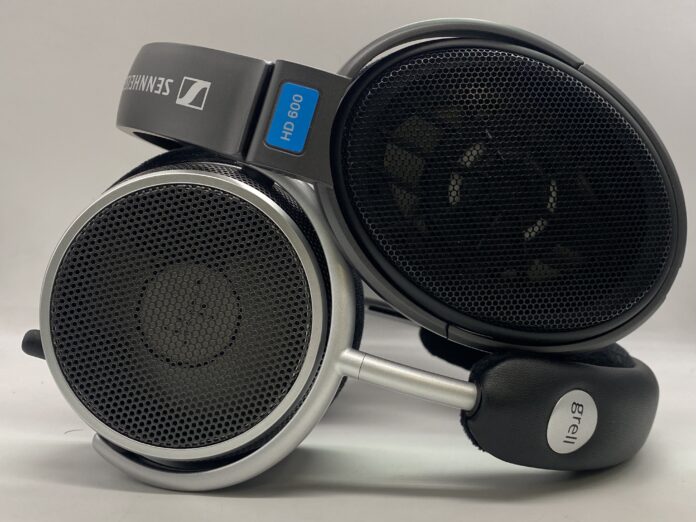
Open-back headphones often fall into two categories: those that redefine how we experience sound, and those that perfect what already works. The Grell OAE2 and the Sennheiser HD 600 represent these opposing philosophies. One aims to rethink spatial presentation entirely, while the other remains a benchmark for neutral, reference-grade listening. If you’re deciding between innovation and legacy, this comparison breaks down exactly where each headphone excels.
What You Get
| OAE2 | Sennheiser HD 600 |
|
|
Look & Feel
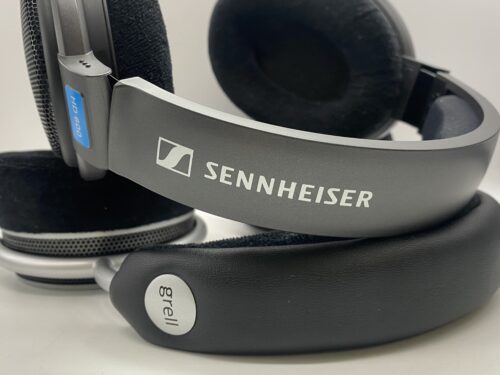
Build quality is solid on the OAE2, with a lightweight frame and plush padding, though the aesthetic is relatively understated. In contrast, the Sennheiser HD 600 sticks to a classic, no-frills design. It uses a durable plastic chassis with aluminum reinforcements and velour padding that prioritizes comfort over flash. The clamp force can feel slightly firm, but overall, the ergonomics are dependable and time-tested.
Design
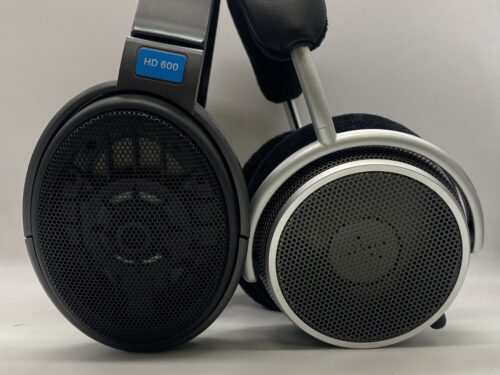
Both the Grell OAE2 and the HD 600 are dynamic open-back headphones. The Grell OAE2 utilizes a bio-cellulose dynamic driver combined with a unique damping system and forward-facing placement. This design is specifically tuned to create a more externalized sound field, mimicking how speakers interact with your ears. The HD 600, on the other hand, uses a more traditional dynamic driver configuration with a high 300-ohm impedance, requiring proper amplification to reach its full potential. Its tuning focuses on linearity and accuracy rather than spatial experimentation.
Soundstage
The Grell OAE2 clearly takes the lead in spatial presentation. Its soundstage is wide and “semi-holographic,” offering strong imaging and a sense of space that extends beyond the head. The HD 600, while competent, feels more intimate. Its soundstage is comparatively narrower, with less perceived openness and depth. Instead of forming a traditional left-right stereo image inside your head, the OAE2 pushes elements outward, giving instruments more breathing room and a more speaker-like projection. Imaging is particularly strong here, with sounds occupying clearly defined positions that feel layered rather than stacked. The HD600’s imaging is still extremely accurate within its smaller stage, making it excellent for pinpointing placement in dense mixes, even if it doesn’t feel expansive.
Low End
The OAE2 delivers a controlled and balanced low end with good extension. It avoids overwhelming the mix while still providing enough presence to support the overall sound. The HD 600’s bass is tight and accurate but less impactful. It prioritizes control over punch, making it ideal for analytical listening rather than energetic genres. With the OAE2, there’s a noticeable sense of depth in sub-bass regions, which helps give electronic and cinematic tracks a stronger foundation. Bass notes on the HD 600 are well-defined and articulate, making it easier to analyze individual layers in a mix. However, listeners looking for physical impact or rumble may find it slightly lacking compared to more modern tunings like the OAE2.
Mids
This is where the HD 600 shines. Its midrange is widely regarded as a benchmark for neutrality, delivering pristine fidelity with no distortion or coloration. The OAE2 also performs exceptionally well here, offering clear, transparent mids with strong vocal presence and articulation. However, it leans slightly more relaxed and spacious rather than strictly neutral. There’s a natural tonal weight to the HD 600s mids that makes everything from acoustic recordings to vocal-heavy tracks sound lifelike and uncolored. This is the kind of midrange that reveals subtle nuances in performances, which is why the HD 600 is still widely used for mixing and reference listening. If you can do without the analytical sound profile, the OAE2 gives you a more immersive and less critical listening experience, though it doesn’t quite match the HD 600’s surgical precision.
Highs
The OAE2 presents highs that are airy, detailed, and controlled, avoiding harshness while maintaining clarity. If you like slightly brighter highs, the HD 600’s treble offers strong detail without becoming piercing, though it can feel more forward depending on the track. Those who like more openness will prefer the OAE2. It enhances spatial cues, making reverb tails and ambient details more apparent in the mix.