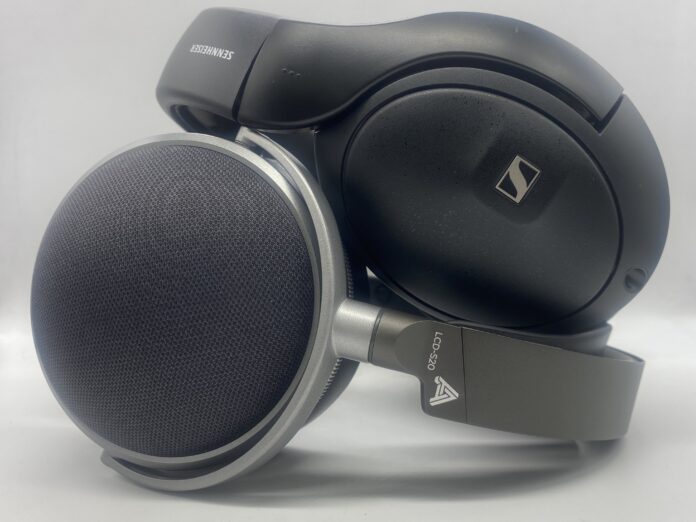
Closed-back, critical-listening headphones take center stage in this comparison. The Sennheiser HD620S is a 120-ohm dynamic-driver headphone offering balanced, detailed sound with strong isolation. Meanwhile, the Audeze LCD-S20 uses 90 mm planar magnetic drivers and Audeze’s SLAM technology to deliver studio-grade accuracy and a neutral tonal balance in a sealed design. Both models aim to satisfy listeners who need closed-back designs without compromising on fidelity.
What You Get
| HD 620S | LCD-S20 |
|
|

Look & Feel
The Sennheiser HD620S is built with a hybrid plastic and metal headband that feels sturdy while remaining lightweight. Its plush protein-leather ear pads are designed for long listening sessions, though some users may find the clamp force slightly tight. One detail that may cause frustration is the locking connector jack, which can be a bit tricky to insert cleanly. However, the build feels reliable and comfortable overall.
By contrast, the Audeze LCD-S20 features a rugged yet lightweight chassis made of magnesium, aluminum, and steel components. The closed ear cups are fabric-wrapped, and the pads are fully replaceable, which adds to the headphone’s durability. Comfort is generally solid, but the headband offers limited adjustment options, which could make the fit less than ideal for certain head shapes.
Design
The HD620S, with its 120-ohm impedance, is relatively easy to drive and performs well even with compact USB dongles and portable DACs. Its forgiving balance and solid isolation make it an excellent option for casual listening, commuting, or home mixing setups. Audiophiles who want a versatile closed-back without losing Sennheiser’s classic tonal balance will find it appealing.
On the other hand, the LCD-S20 is designed with professionals in mind. Its planar magnetic drivers and neutral tuning make it particularly suited for studio engineers and producers who demand a flat, accurate reference. At just 18 ohms, it is also very easy to drive, even with portable devices, but its true strength lies in mixing and mastering contexts where absolute transparency is required.

Soundstage
One of the most impressive qualities of the HD620S is its surprisingly wide soundstage for a closed-back headphone. Imaging is precise, and the layered presentation makes the headphone feel more open than one would expect from a sealed design. This quality sets it apart from many closed-backs in its class. The LCD-S20 takes a different approach, offering a soundstage that feels more linear and compact, almost like working inside a well-treated control room. While it lacks the expansive width of the HD620S, the spatial accuracy and imaging remain clear and dependable. For studio professionals, this more intimate presentation may actually be preferable when mixing and monitoring.
Low End
When it comes to bass performance, the HD620S leans toward a neutral and linear low-end. It delivers smooth resolution that works well for critical listening and mixing, but those who crave a heavy, visceral bass response may find it a little restrained. The LCD-S20 also avoids an overly boosted low-end, presenting tight, precise bass with excellent clarity. While the neutrality makes it excellent for monitoring, listeners who prefer a punchy or cinematic low-end may need to add some EQ.
Mids
In the midrange, the HD620S shines with an airy and clean presentation that reveals layers in instruments and vocals. Vocals, in particular, sound natural and uncolored, making this headphone ideal for long mixing sessions or music enjoyment without fatigue. The LCD-S20 also excels in midrange clarity, with crisp and forward reproduction that highlights detail in mixes. However, this precision can make vocals sound more pointed, which some listeners may perceive as slightly fatiguing over time.
Highs
The treble response on the HD620S is another strength, offering a forward and detailed presentation without harshness. The sound has sparkle and energy while avoiding the so-called “Sennheiser veil” found in some of the brand’s older models. On the LCD-S20, the highs are equally well controlled, with a graceful shimmer that makes cymbals and atmospheric details come alive. The treble feels open and defined, adding to its value as a mixing tool, while avoiding excessive brightness.
Summary
The choice between the Sennheiser HD620S and the Audeze LCD-S20 depends largely on the listener’s priorities. If you want Sennheiser’s classic balanced tuning paired with an unusually wide soundstage for a closed-back headphone, the HD620S offers an impressive mix of performance, comfort, and versatility. It is an excellent all-rounder for both audiophile enjoyment and light mixing work.
If your needs lean more toward studio applications, the Audeze LCD-S20 is a better fit. Its neutral tuning, planar magnetic accuracy, and durable build make it a reference-level tool for mixing and mastering. While it may not be as engaging or spacious as the Sennheiser, it delivers the precision and transparency professionals require.
The Audeze LCD-S20 and the Sennheiser HD 620S are available at Audio46.